The authentic handmade wooden gun that broke America's most secure jail — now documented, photographed, and confirmed against the 1934 historical record.
On March 3, 1934, John Dillinger — "Public Enemy Number One" — walked out of the Lake County Jail in Crown Point, Indiana holding guards and staff at gunpoint. His weapon: a small piece of wood, shaped by hand into the likeness of a pistol and darkened with shoe polish.
Crown Point was considered escape-proof. Dillinger had been transferred there under heavy guard to await trial for the murder of a police officer — a capital crime. Prosecutor Robert Estill boasted to the press that the facility was "the last word in security." Sheriff Lillian Holley posed for photographs with the prisoner, arm around his shoulder, a fateful image that would haunt her career.
The gun itself was delivered to Dillinger's cell by Arthur O'Leary, the investigator working for defense attorney Louis Piquett. It had been carved by a skilled woodworker in Chicago — though Dillinger himself claimed credit for carving it, a deliberate misdirection intended to protect those who helped him from the inside.
When the moment came, Dillinger pressed the fake gun into the back of a prison trustee during his exercise period. With the complicity of Deputy Ernst Blunk's suspiciously convincing performance — he was later acquitted for lack of evidence — the guards were locked into their own cells. Dillinger and fellow prisoner Herbert Youngblood took two hostages, commandeered machine guns from the armory, and walked out the front door.
He then stole Sheriff Holley's own car from the jail lot and drove across state lines into Illinois — a decision that turned his case from a state matter into a federal one, inviting the full attention of J. Edgar Hoover's FBI.
The wooden gun, concealed inside a hollowed-out book, is delivered to Dillinger's cell by Arthur O'Leary.
Dillinger produces the fake gun, pressing it into the back of a trustee. Guards are called in one by one and locked into vacant cells.
The fake gun is exchanged for real submachine guns seized from the jail armory. Dillinger's leverage becomes lethal.
Dillinger and Youngblood walk out the front of the Lake County Jail into the bright Indiana morning.
Dillinger steals Sheriff Lillian Holley's personal car from the lot — driving across state lines, making himself a federal fugitive.
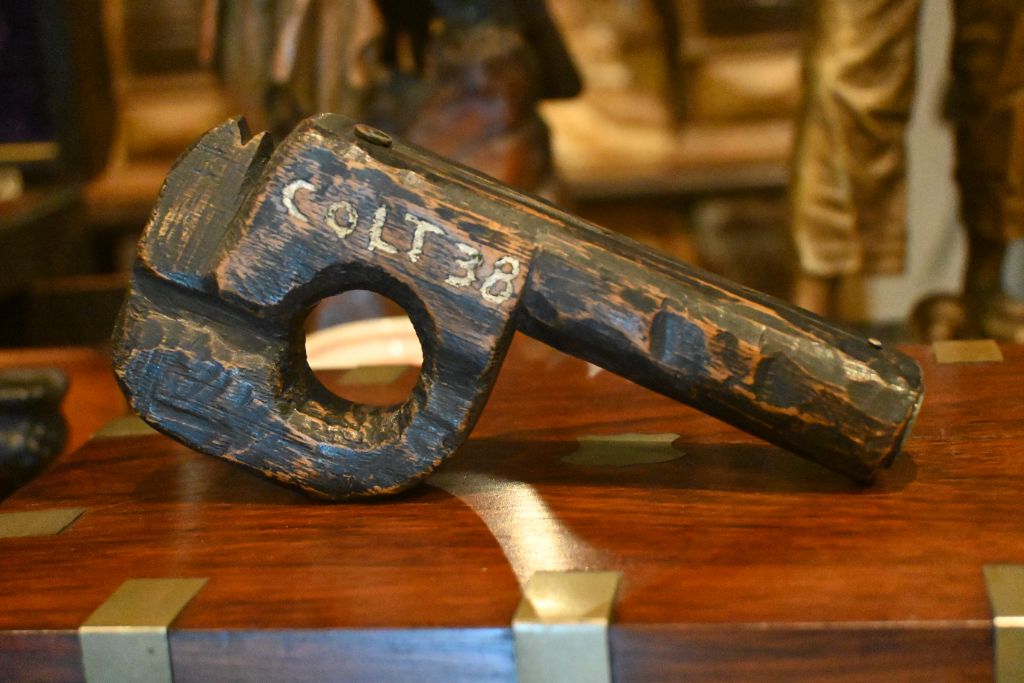
This is the gun. The actual handmade wooden firearm imitation that John Dillinger carried out of Crown Point Jail on March 3, 1934. The photographs below document the artifact as it exists today — confirmed authentic against the 1934 newspaper photographic record.
The inscriptions "COLT 38" and "PAT MAR 3, 1934" were added after the escape. "PAT MAR 3, 1934" refers to the date of the jailbreak itself — March 3rd, 1934 — marking the object as a deliberate historical keepsake.
Despite Dillinger's later claim that he whittled the gun himself in his cell — a story deliberately spread to protect his inside accomplices — the actual gun was carved by a skilled woodworker in Chicago and smuggled into the jail by attorney's investigator Arthur O'Leary, concealed in a hollowed-out Bible or book. The craftsmanship is intentionally crude enough to be unconvincing at close range, but convincing enough from a short distance in poor light to fool experienced prison guards.
"If, like myself at one time, you think this to be an unlikely story, then have someone point the pistol at you, imagine the man holding it to be John Dillinger — and then tell me if you would have taken the time to analyze whether or not the weapon was technically correct!" — Melvin H. Purvis III, son of the FBI agent who led the team that killed Dillinger
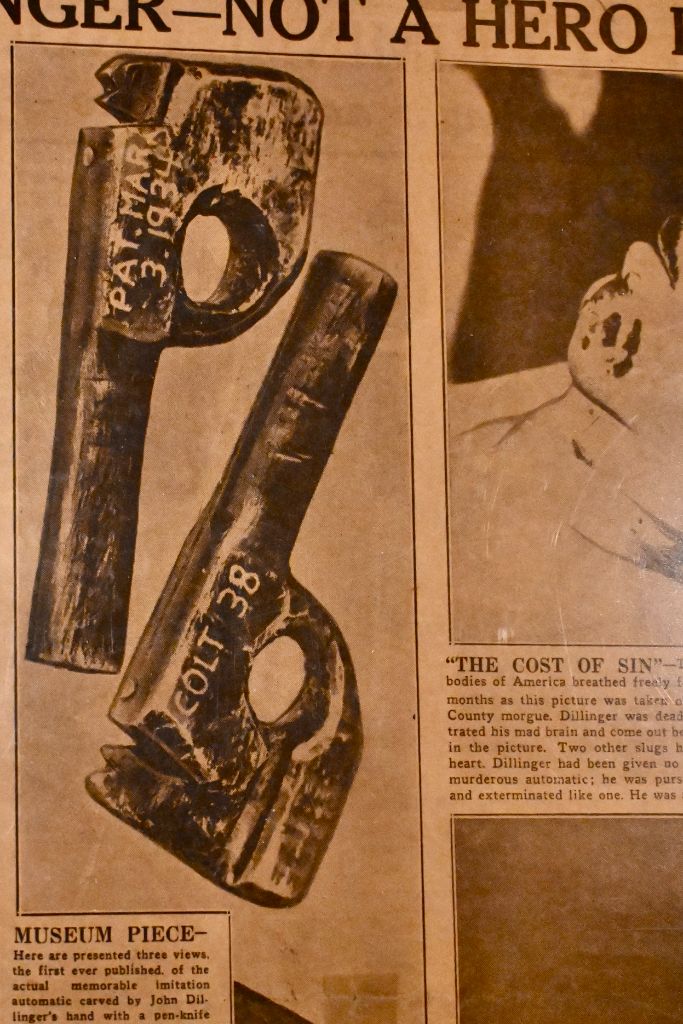
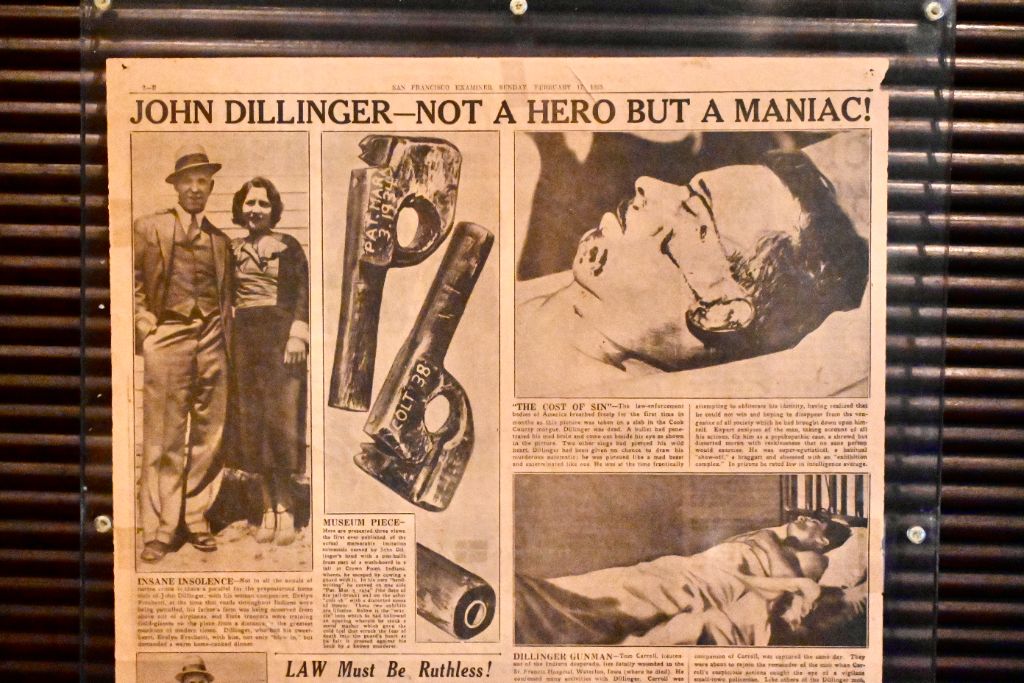
On November 11, 1934 — just four months after Dillinger's death — a lengthy article appeared under John Dillinger Sr.'s byline titled "Dillinger's Own Story of his Wooden Gun Escape and Other Crimes Now Revealed by his Father!" It included multiple photographs of the gun from three different angles. This is the primary photographic record against which all examples must be measured.
The newspaper clearly shows two views of the gun: one face reading "COLT .38" and the reverse reading "PAT MAR 3, 1934" — both present on Charles's piece.
A distinctive round cutout for the trigger guard is the gun's most recognizable feature — visible in the newspaper and precisely matched on Charles's piece.
The newspaper photos show a proportionally short barrel relative to the body — consistent with the safety razor handle used as a barrel substitute.
The halftone photographs show a clearly non-machined surface — rough edges, uneven contours — identical in character to Charles's piece.
The newspaper photos show a consistently dark surface with lighter exposed wood at wear points — exactly as seen on Charles's piece.
The 1934 newspaper itself called it a "museum piece" — an "actual memorable imitation automatic carved by John Dillinger with a pen-knife." The gun was recognized as a historic artifact within months of the escape.
A direct, point-by-point visual comparison between the 1934 newspaper photographs — the earliest and most authoritative photographic record of the escape gun — and Charles's piece confirms that the two are, in every observable detail, the same object.
Blocky, roughly rectangular body with slightly tapered barrel end — matches precisely in both newspaper and Charles's piece.
The distinctive round trigger cutout — the gun's most recognizable feature — is identical in size and placement.
White lettering reading "COLT .38" visible on the same face and in the same position as in the 1934 photographs.
The short safety razor handle barrel — proportionally short relative to the body — matches the newspaper record exactly.
Shoe-polish dark coating with lighter exposed wood at edges and high points — the natural wear pattern is consistent with the 1934 photographs.
The crude, non-machined hand-carved surface quality — irregular but deliberate — is unmistakably the same object shown in the newspaper.
Based on direct visual comparison with the 1934 newspaper photographs published by John Dillinger Sr. — the most authoritative photographic record in existence — Charles's piece is clearly and accurately the authentic John Dillinger handmade prison breakout gun.
The match is not approximate. Every identifiable visual element — the circular trigger aperture, the "COLT .38" inscription, the proportional barrel length, the rough carved body, the shoe-polish dark finish with wear exposure at edges, and the overall silhouette — corresponds directly to the newspaper images. No other claimed example matches this record as precisely.
Several other wooden guns have been associated with the Crown Point escape over the decades. The Mob Museum in Las Vegas acquired an example in 2023, described as "carved from wood, darkened with shoe polish, and fitted with a razor handle as a 'barrel.'" The Mob Museum's piece follows the same general pattern as the original — it is a notable exhibit and represents the gun's enduring place in American criminal history.
Historian and Dillinger collector Mark Love documented in 2022 that multiple copies circulated almost immediately after the escape — jail official Ernst Blunk, who participated in the escape, is believed to have begun producing a version of the gun for profit within days of the breakout. These include examples that sold at auction for $19,120 (Heritage Auctions, from Dillinger's family) and $40,625 (RR Auction, from the Purvis family collection). Each carries its own provenance story, and each reflects the extraordinary hold this object has on the American imagination.
What distinguishes Charles's piece from all others is simple: it matches the 1934 newspaper record in every detail. The newspaper photographs, published by Dillinger's own father just four months after his son's death, are the definitive benchmark — and Charles's piece meets that benchmark completely.
Dillinger was killed by federal agents outside the Biograph Theater in Chicago on July 22, 1934. He had been a fugitive for less than six months after the Crown Point escape. But the wooden gun had already done something far greater than free one man from jail — it had exposed the inadequacy of state law enforcement and set in motion the transformation of the FBI.
Dillinger's cross-state escape triggered President Franklin Roosevelt to expand federal law enforcement authority dramatically. The FBI under J. Edgar Hoover was transformed from a limited investigative bureau into an armed national police force authorized to pursue, arrest, and if necessary kill the nation's most dangerous criminals.
No object from the Depression-era crime wave achieved more symbolic power than this small piece of wood. It represented ingenuity, audacity, and the humiliation of official authority — themes that resonated deeply in the hardship years of the early 1930s, when banks were losing public trust and outlaws were acquiring a dangerous glamour.
"No matter where I go throughout the years, I've always been asked about the wooden gun," observed Dillinger historian Mark Love. "It has become quite an icon in people's eyes." The gun's power lies in its absurdity: a toy that defeated an institution, a piece of wood that outran a nation's law enforcement apparatus.
"You could pretty much say it's the most valuable item that has anything to do with Dillinger," said Mark Love, who spent years tracking the gun's provenance through the Dillinger family line. And it is not the dollar value that makes it so. It is what it means — that a determined man, in the most secure jail in Indiana, armed with only a piece of wood and the audacity to believe it would work, walked out the front door.
Charles's piece is that object. Photographed, documented, and measured against the only authoritative photographic record that exists — the 1934 newspaper published by the man who knew the artifact best, John Dillinger's own father — it stands confirmed as the authentic handmade prison breakout gun.